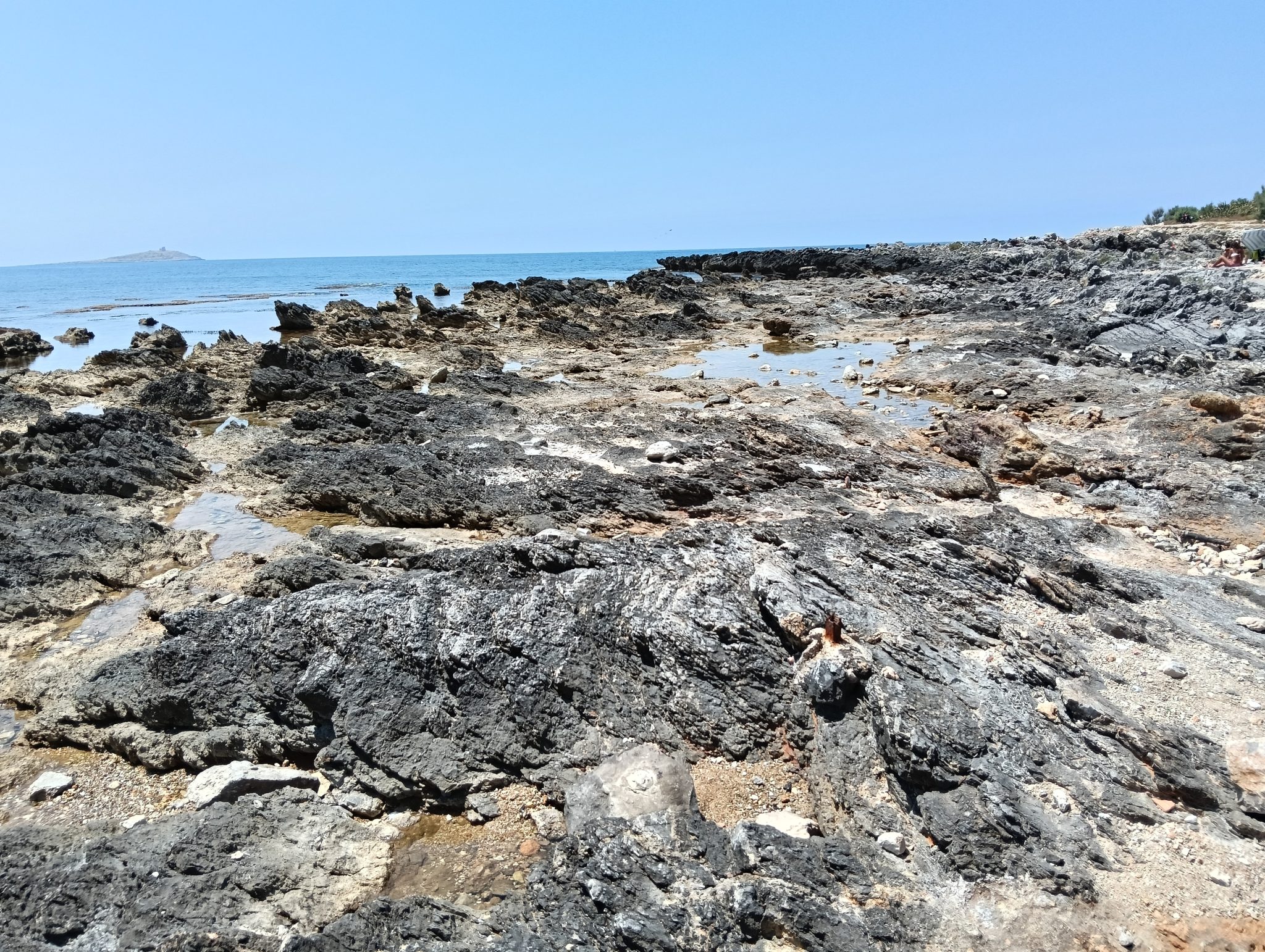
The tide had just pulled back far enough to show how the cliff is put together. Grey over brown over grey again, each band a different season of some enormously slow process that finished long before anyone was around to watch it.
I had come for the lighthouse further along the head, which I did not photograph at all. This happens more often than I would like to admit. You plan for one thing, arrive, and the ground in front of you turns out to be more interesting than the landmark you drove two hours to see.
Flat light is honest
The sky was the colour of an unwashed window and stayed that way all morning. Every guide will tell you this is bad light, and for a wide landscape they are right. For texture it is the best light there is. Nothing throws a shadow, so nothing hides. The rock had to compete on its own terms.
I worked along about thirty metres of it, crouched most of the time, moving whenever the water let me. The bands run at a shallow angle, so the trick was finding a spot where the frame could sit square to them without the horizon sliding into the corner.
Every cliff is a stack of bad weather that happened a long time ago.
A geologist I once shared a train with
That line has stuck with me for years and I have never been able to verify it, or find the man again. It is not quite true, geologically speaking. It is entirely true as a way of looking.
What I would do differently
Get lower. I keep writing this in my notes and keep not doing it, because getting lower here meant kneeling in a rock pool, and I had a train to catch. The frame would have been better for it.
The tide turned while I was packing up and the whole lower third of these photographs was underwater within forty minutes. There is a version of this post where I stayed, and it is a better one.
Leave a Reply